Showing posts with label vegetarian. Show all posts

Wednesday, December 30, 2020

Cooking During the Pandemic

ফুলকপি ডাল  
Cauliflower Daal 


Cauliflower daal with brown rice


What a year its been. Apart from that, I don't think I have much to say. 

Like many of us, I've spent a lot of the year inside - food shopping in bulk to avoid being in busy public places for too long. That's meant a lot of cooking at home, and while for me that's been an unexpected blessing, most of what I've cooked has been the usual curries, stir-fries and simple pasta dishes. 

And despite the pandemic, work has been as busy as ever. Only now at the end of the year am I taking a bit of a break, and this is my chance to share a quick recipe. In the last few months I've gotten better at cooking Bangladeshi and South Asian vegetarian food - making different types of daals and experimenting with spiced shobji bhajis and Bangla-Chinese stir-fries. This is mainly because of the frozen veg I started buying when fresh produce ran out near me. The larger portions frozen veg comes in meant learning to cook bigger veggie dishes rather than just side dishes. 

This slightly spiced vegetable daal is a result of that - nothing too glamorous and indeed quite similar to another daal recipe I shared a while back. I originally cooked it using frozen cauli, but I've reduced the cooking time assuming fresh cauli in the instructions below. I also like the veg in my daals to be quite mushy, so do reduce the cooking time further if you want more crunch. The recipe below makes enough for 6 portions as a side, or perhaps 4 as a main. It's great comfort food if you like daal, and in normal circumstances I would serve this with rice and another protein course. 


Ingredients:
  • 140.00 g or mushur daal (red split lentils)
  • 1.00 teaspoon of garlic paste
  • 1.00 teaspoon of ginger paste
  • 0.50 teaspoons of turmeric
  • 0.50 teaspoons of powdered chilli
  • 0.50 teaspoons of powdered coriander seed
  • 0.50 teaspoons of powdered cumin seed
  • 1.00 teaspoon of whole cumin seeds
  • 2.00 tablespoons of cooking oil, any type
  • Half a head of fresh cauliflower
  • 60.00 g of frozen peas
  • 2.00 cloves of garlic
  • 2.00 fresh green chillies
  • 2.00 tablespoons of mustard oil
  • Salt, to taste

Method:
  • Place the daal in a large bowl and fill with water. Wash it thoroughly, draining away the water and repeating the washing process until the water runs mostly clear
  • Leave to soak for a few hours - this will help the daal cook quicker later
  • Place a deep saucepan on the hob over medium heat, and add the cooking oil
  • Once the oil has heated add the garlic and ginger pastes, along with the dry spices
  • Mix thoroughly, and allow to cook for a couple of minutes
  • Drain the daal and add it to the pan. Mix the spices and daal together, and allow to cook for 2-3 minutes
  • While the daal and spices are cooking, boil a litre of water in an electric kettle. Pour the water into the pan, giving the daal a good stir. Partially cover the pan and leave to cook for 25-30 minutes, lowering the heat slightly
  • After 30 minutes have passed, chop the cauliflower into smaller bite size pieces and add to the daal. Partially cover the pan again, and leave to cook for 10-15 minutes
  • After the cauliflower and daal have cooked together for at least 10 minutes, put a small frying pan on medium-low heat and add the mustard oil
  • As the oil heats up, chop and add the garlic cloves. Once they've begun sizzling add the fresh chillies and cumin seeds, continuing to fry for about a minute, before taking the frying pan off the heat
  • Check on the daal, stirring lightly to check if the cauliflower is cooked and tender and the daal has broken down into a creamy base. At this point, top up with some more freshly boiled water depending on the consistency of daal desired
  • Add the mustard oil, garlic, chilli and cumin seeds from the frying pan to the daal - followed by the peas
  • Leave to cook partially covered for a final 10 minutes, before taking off the heat
  • Serve hot with rice, as a main for a simple meal or as a side as part of multiple courses 

Wednesday, August 1, 2018

Cooking on the Trail

সবজি ডাল  
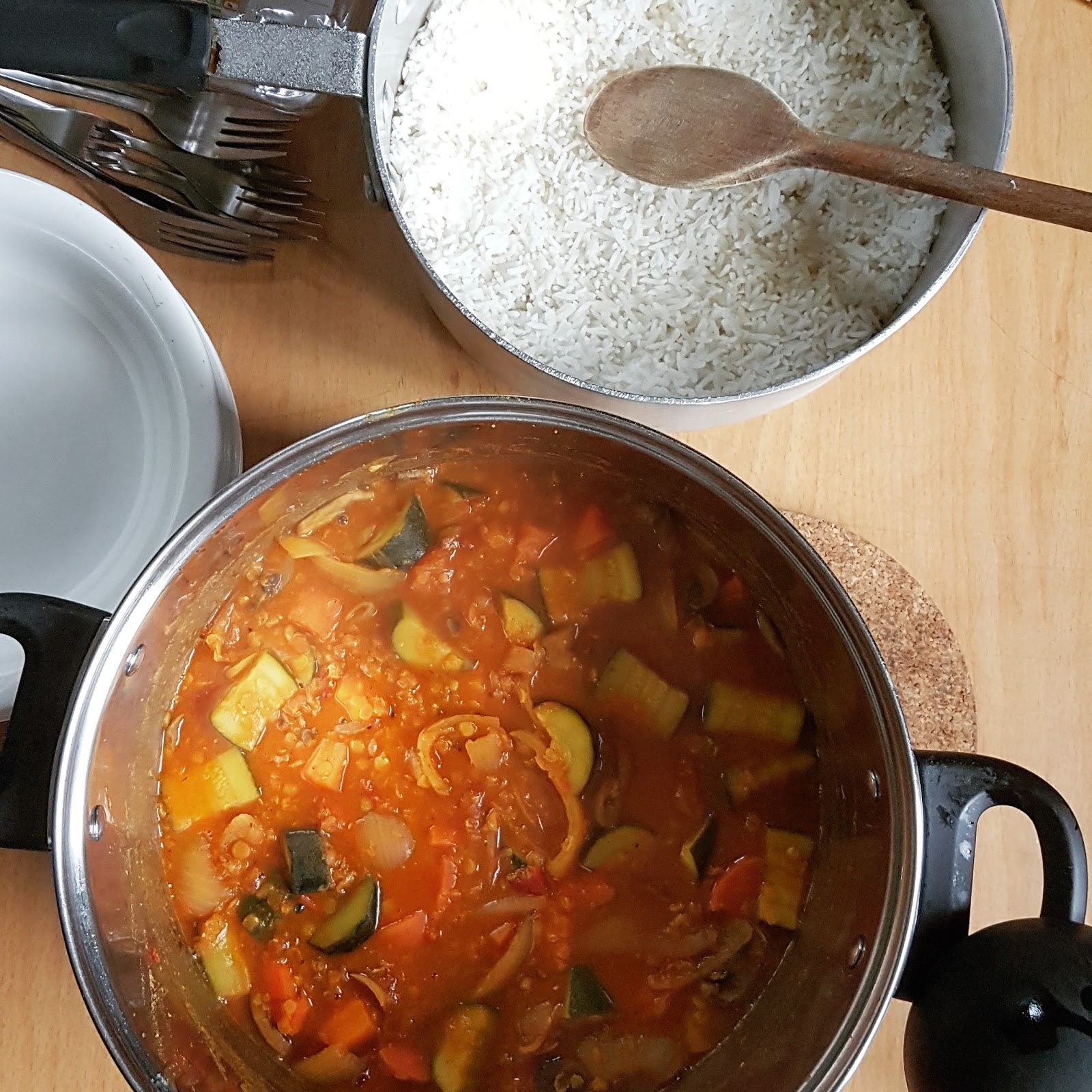
Daal with Vegetables


Spiced daal with vegetables


I spent a weekend in Glen Affric earlier this summer, staying at an off-the-grid hostel while attempting to climb some local munros. The hostel itself was quite unique - 13 kilometres from the nearest road and powered solely by a wind turbine and solar panels. This is enough for lights and some heating, but not much else. Cooking is done on gas stoves - supplied by cylinders that are transported in using off-road vehicles. The remote location also makes it difficult to carry supplies onto site regularly, and guests are encouraged to bring food for their own trips. I was travelling with a group of friends, and we all pitched in to carry enough for 3 days. But this was 3 days without access to refrigeration, and we had to make sure everything we brought was non-perishable. 


Did I mention Glen Affric was beautiful?! 


I was in charge of dinner on day 2, and I had to think of ingredients that would cope well without a fridge. Hence I opted for daal with vegetables - but spiced up a little to make it work as a main event. I was a little worried about feeding a group of hungry hikers something like this, especially as at my family table daal would never be more than a side dish. So I decided this iteration needed to be richer, and I immediately knew I'd be using meat spices as a base. I've also always loved tart daals with jolpai and green mango - so I replicated that tartness here with tinned tomato. For the veg, I opted for carrots and courgettes because they were tough enough to survive the journey in our backpacks. The result was a spicy, tangy and thick daal: something I know I'll be cooking for years to come. The recipe below serves 6 generously. 

Monday, May 7, 2018

Vegan Bangladeshi

নিরামিষ

Mixed Vegetables


Mixed vegetables with panch phoron


Don't worry about the title, I've not gone vegan. I'm just finally confident enough about my veggie cooking skills to share this recipe. I'm not sure quite why it took me so long to get here, but vegetables don't come to me as naturally as meat. I find it more difficult to get the flavours right, and the cooking times correct. However, I am trying to eat more of them, while at the same time cutting down on meat for health and environmental reasons. Right now I'm helping this process along with a bright and interesting recipe for mixed vegetables with panch phoron, a staple of most Bangladeshi kitchens. Aside from simple turmeric-and-chilli stir fries and hearty mashes, this is how I'd expect vegetables to be eaten in a Bangladeshi household. In our family, vegetables cooked this way could be served for breakfast, lunch or even dinner - though hopefully never all on the same day!

Panch phoron is a five-spice mix consisting of cumin, fennel, fenugreek, black mustard and nigella seeds. If you're not in Bangladesh, don't fret. The mix is commonly stocked in many Asian corner stores and supermarkets around the world. Of course, you can always make up your own mixture, using each component in equal amounts. My most vivid memories of panch phoron are from its use in pickle-making, along with cooking vegetables like this. In my mind, panch phoron is to cooking what colour-blocking is to the fashion world. In most dishes I make, the spices come together and create a unique new flavour - like a colour-coordinated school uniform. It's not so with panch phoron, where instead it feels like the different flavours all compliment and bounce off each other. If you're not Bangladeshi, this spice mix may feel like an acquired taste. 

The recipe below is quite long, but only because I've broken it down into simple, easy-to-follow steps. I would advise not using store-bought garlic and ginger pastes here. The short cooking time won't rid them of their vinegar-y smell. You wouldn't normally encounter chickpeas in this dish, but the eateries near my late nani's all make their shingara fillings this way. Inspired by them, I've included chickpea in my recipe too. It adds some protein, and helps me turn this into a one-dish dinner for weeknights.

Finally, a few notes on the cooking times. These will vary depending on the vegetables used. Fresh, younger plants will cook faster than the older and tougher. Equally, there will be differing opinions on what constitutes "cooked". Some people prefer everything in this dish to go soft and mushy, while others prefer their vegetables to retain a slight crunch. In our family, we opt for the crunchier version of this dish, unless we're serving it for breakfast. For breakfast, we cook this for longer than stipulated below, and with more water. The end result would be soft dollops of vegetable and a tiny bit of broth - ideal for scooping up with ruti! Do experiment with timings and combinations that suit your own preferences. The recipe below serves 4 as part of a larger Bangladeshi meal. 

Monday, January 29, 2018

Basic Bangladeshi Greens, Part 1 of n

Swiss Chard with Mustard & Fennel Seeds

সরষে ও মৌরি দিয়ে সুইস চার্ড 


Messy but delicious


I bought Swiss chard by mistake the other week. Embarrassingly, when I got home and unpacked my groceries, I didn't recognise the plant for what it was. I tentatively trimmed and washed some of it, then cooked it into mac & cheese. I was counting on the smoked cheese from my sauce to cover up any weird tastes or smells. It turned out the apprehension was unnecessary, as eventually someone on Instagram confirmed it was just chard! Chard I could work with, and I initially contemplated cooking the remaining plants just like spinach. Our family relies on the tried and tested garlic-and-chilli combo to cook most of our leafy vegetables, expect for maybe potato leaves and thankuni patha. 

But then I reconsidered, and began wondering how I could incorporate mustard into the dish. I've been a little obsessed with mustard since moving to Scotland, and I go through this thought process for pretty much everything I cook now. I decided ground mustard seeds would work quite nicely as a base flavour, with some fennel seeds as complement. I rounded off the ingredients list with a little turmeric for colouring, and some sliced onion to ease the frying process. The result was a win: think soft pieces of plant peppered with caramelised onion, each mouthful accentuated by a slight prickly heat from the mustard. I'm definitely adding this to my regular vegetarian repertoire. Speaking of which, I'm hoping to post more recipes for easy to cook greens, hence the title of this post. The recipe below makes enough for 2 as a small side, but scales up quite easily. 


Tuesday, January 2, 2018

New Year's Eve Snacking

ডালের বড়া 
Daaler Bora or Lentil Fritters

My batch of NYE daal bora, all plated up for us to devour

Happy New Year everyone! To kick-off 2018, I'm posting a very traditional recipe for daaler bora, or lentil fritters. 

The daaler bora is very different from the other fritters I've written about for the blog. First of all, it has no flour - gram or otherwise - and the daal or lentil is what goes straight into the hot oil. Secondly, making a batch of them is a bit of a challenge: the lentils need planned pre-soaking, followed by blending and careful frying to avoid disintegration. Oddly enough, in generations past they were considered an easy enough snack to whip up. I assume this is because households would have lentils soaking anyway as part of their daily routine, and making daaler bora would just involve swiping some from that stash. Things have changed nowadays though, and in our family the daaler bora is usually bought from neighbourhood eateries - at least when we're in Bangladesh. It's much less frequently made at home, and usually only for special occasions like Ramadan, when it's an iftaar staple. In general, the daaler bora is a tea-time snack, though it can also be eaten as a side during a larger meal. The fritters are also the first phase of another dish called the doi bora, though I'm not a big fan.

The ingredients used vary from family to family, and change between Bangladesh and the rest of South Asia, as well as between Hindu and Muslim families. My family recipe is quite basic, using only one type of lentil, salt, chilli, turmeric and onion. Other families may use a mix of different lentils, and also add spices and herbs to liven things up. In the recipe below I've added coriander, but otherwise I've kept things pretty simple. I've also snuck in a bit of baking powder, something one of our chefs taught me to do, as it makes the boras stay crunchier for longer. This is really useful if you want to make them a little ahead, as I was doing to take to a New Year's party an hour away. Boras like these are usually served with dips and sauces. I served my most recent batch with sriracha, but tamarind-based sauces or ketchup are the more common accompaniment. The recipe below makes about 24 boras, each about 3.00 centimetres across. 

Tuesday, June 27, 2017

Korola Masochism

করলা ভাজি
Stir-Fried Bitter Gourd


Stir-fried bitter gourd garnished with red chilli

I've moved to a neighbourhood with a Bangladeshi store around the corner! Unsurprisingly, I've been re-living all kinds of childhood food memories. I try not to buy perishables with lots of air miles, but I couldn't resist picking up a couple of fresh looking bitter gourds the other day. Bitter gourds, or korola, get their name from the very distinct bitter taste they retain even after cooking. Despite this, they are unreasonably popular back home, probably because the fruit has long been associated with alleged health benefits. I've heard people claim it does everything from curing an upset stomach to preserving healthy eyesight. 

I suspect the fruit I bought (photo in this post) is from India, as commonly available Bangladeshi varieties are quite small. They're eaten green and unripe, usually fried but also on occasion mashed or stuffed. Folks have various methods of dealing with the bitterness. The most common technique I've come across is to cook the gourd in lots of oil with plenty of onion and potato to distract from the bitter taste. On a similar principle, some people garnish the gourd with chopped coriander or squirt lime onto the dish to mask the taste with sour notes. Others soak the fruit in salt-water to counteract the bitterness, though I have never tried this myself. 

My family was quite masochistic when it came to korola though - we'd often have it without any onions or potatoes - fried in a bare minimum of oil, salt and turmeric.  The recipe below is a little more conventional, with onions and potatoes left in. Be as healthy or unhealthy as you want with the amount of oil. This makes a good side as part of a larger meal - it's the kind of everyday dish cooked alongside plain rice and simple chickenGiven my childhood hatred for vegetables, I find it hard to believe now that I liked this dish quite so much!


Friday, June 16, 2017

Breakfast during Mango Season

আম দিয়ে দুধ-ভাত
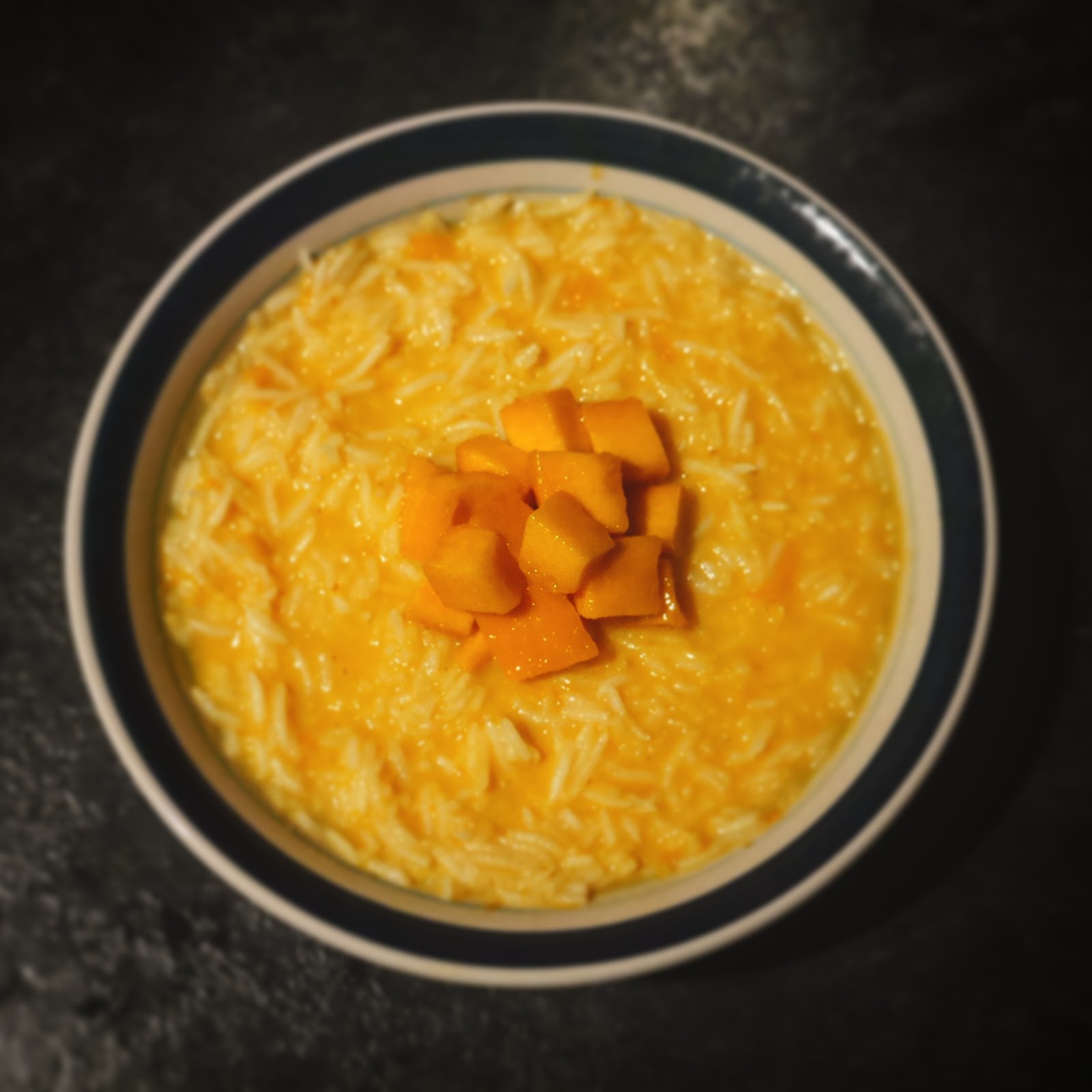
Rice with mango-milk


Rice and mango-milk, topped with mango
What's not to like? :) 

It's mango season! In Bangladesh this means a glut of mangoes everywhere. Their sheer number has people scrambling to find ways to use them up. On top of cooking, pickling and drying, making mango-milk is another common way we at the fruit growing up. We mixed the pulped flesh of a sweet, ripe mango into hot milk, creating a warm alternative to the mango lassi. Sometimes, we would pour this onto rice - the result of a family habit of pouring any kind of milk onto rice. In fact, whenever we didn't like the food on offer for a particular meal, rice with milk was the go-to substitute dish for the kids in my generation. 

Of course, unconventional meal replacements aside, this dish makes a great breakfast. I also have it for seheri (the pre-fasting meal during Ramadan), as it makes a nice change from cereal. Folks who've had Thai mango with sticky rice will be familiar with the flavour and textures. To make this, you want mangoes that almost melt when crushed, rather than those with firm, springy flesh. In the UK, safe bets are South Asian mangoes sold as Alphonso or Kesar. When fresh mangoes aren't in season, tinned mangoes are another option. The recipe below makes a full "meal" for one, or serves two to three as a snack.

Ingredients:
  • 1.00 small South Asian mango (around 175.00g whole, unpeeled)
  • 150.00 g cooked rice
  • 100.00 ml whole milk
  • Sugar, to taste

Method:
  • Heat the milk in the microwave for a minute
  • While the milk is heating, peel and slice the mango
  • Crush the flesh to form a pulp, and remove any overly large pieces of fibre 
  • Mix the mango into the milk, and taste for sweetness. Add sugar if desired
  • Place the cooked rice in a bowl. Pour in the mango-milk and mix
  • Serve while warm

Additional Info
If you want something a bit richer, heat and thicken the milk on the hob before adding the mango. For a different flavour, swap the mango for banana, something we would also do quite commonly in our family. 

Sunday, April 9, 2017

Cholar Daal and Eggs for Breakfast

ছোলার ডাল

Cholar daal


Cholar daal
Topped wit a fried egg, coriander and black pepper


It's taken me a while, but I finally have most of my family's recipes for daal written down. We usually serve them simply - but this cholar daal is a little unusual. Spiced and cooked like meat, I've been told it's something of a special occasion daal in Bangladesh. However, in my extended family it's always been breakfast food. We eat it with eggs cooked various ways and flatbreads, or sometimes with vegetables and beef curry. As a child, I used the spicing to mask the taste of egg, which I hated. To be fair, even now the eggs in my life come drenched with Hollandaise, filled with cheese or pimped with smoked salmon, so I guess some things never change. 

This dish makes a great accompaniment at a heavier breakfast or brunch, whether it be with eggs, veg or meat. It takes a while to cook, so I'd recommend tackling it the night before you intend to serve it. In the morning, all that's left to do is heat it up (this works well, like reheating curry), make the eggs and bake your flatbreads (which can also be pre-formed). In my book, this is something to attempt for a leisurely weekend brunch rather than during a weekday cooking session. I promise the other daals (coming soon, i.e. whenever I get a craving for them) are simpler and cook quicker. 

Cholar daal soaking

Finally, a quick note on language and ingredients. "Chola" in Bengali means chickpea, and "daal" - translating vaguely - means lentil. Cholar daal together means chickpea lentil, although I realise chickpeas aren't really lentils. The chickpeas you will need for this dish are dried, skinned, and split. They're commonly stocked in Asian food stores. In the UK, they're usually sold under Indian brands and labelled "chana dal". If you're familiar with dried chickpeas you should have no trouble identifying them, but use the photo above to help as well. 


Sunday, April 2, 2017

Delhi Food Memories

সবজি দিয়ে পনির 

Paneer with Carrots and Peas


Paneer with carrots and peas for a nice weekend lunch


I've spent quite a while attempting to recreate a fantastic paneer and mixed vegetable dish our housekeeper in Delhi used to cook. I've gone through various iterations - I added paneer to my standard Bangladeshi vegetable recipe (fail); and then I curried my vegetables like my meat, adding paneer at the end (another fail). What's finally been successful is this tweak of Kaushy Patel's recipe for mattar panner in the GuardianI trust her cooking from my meals at Prasad, which is why I decided to look up her recipes after my failures

To her recipe I've added carrot and toned down the spices, almost halving the ginger and powdered coriander. I've also done away with the deep frying - because who does that at home? Our housekeeper's dish was a lightly-spiced everyday affair, so I've altered Patel's recipe to aline it to that philosophy. Patel does have a paneer and mixed vegetable recipe herself, but that is so heavily spiced that I'm ignoring it completely. The results below aren't exactly the real thing - our housekeeper didn't use tomato as a base - but the dish is satisfying enough that I wanted the recipe written down for future attempts. 


Ingredients:
  • 4.00 cm of ginger
  • 350.00g paneer
  • 400.00g of tinned tomatoes 
  • 2.00 teaspoons powdered chilli
  • 2.00 teaspoons powdered turmeric
  • 2.00 teaspoons powdered coriander
  • 1.00 teaspoon powdered cumin
  • 200.00 g frozen peas
  • 1.00 carrot
  • Salt, to taste
  • Fresh coriander, one handful

Method: 
  • Prep the ingredients first - chop and crush the ginger, finely chop the coriander and cut the paneer and into bite size cubes. Set each ingredient aside separately.
  • Heat some oil in a wok - pouring in enough so that when the panner is added to the pot it is at least partially submerged. Test the oil temperature by adding a cube of paneer - if it begins to sizzle the oil is ready. Make sure to turn the heat down to medium-low before beginning to cook
  • Add the cubes of paneer to the wok, gently turning each cube (I use tongs) as they fry to ensure they are cooked evenly. Remove the paneer cubes from the oil once they've begun to go golden on each side, which should take 3 to 4 minutes. Be careful - the oil will sizzle and jump
  • Open the tinned tomatoes, and stab repeatedly with a knife to break up the flesh. Pour the fruit into the oil and mix, and allow to cook for a minute
  • Follow up by adding the ginger, dry spices, fresh coriander and salt. Mix these ingredients thoroughly into the tomato, and cook on medium low heat for 5 to 8 minutes. The base is unlikely to burn in a non-stick wok, but do stir it a little every minute or so just in case 
  • While the spice base is cooking, take out the peas and leave to soak in water 
  • Boil some water in a kettle
  • Chop up the carrot into bite size pieces
  • Add the carrots to the wok, followed by the paneer. Mix and let cook for a minute, then drain and add the peas
  • Pour in some boiling water to the wok - varying the amount based on how much sauce you want your dish to have. Turn the heat to high, and stir to mix everything together
  • Bring the dish to boil, then turn the heat back down to medium. Partially cover the wok with a lid and leave to cook for 8 minutes
  • Once done, turn off the stove and leave the dish to settle. I usually let the oil come to the surface at this point, and drain or scoop it away 
  • Serve hot with plain boiled rice or flatbreads

Additional Info
If paneer isn't available near you, try this with another squeaky cheese - halloumi - using the same ingredient amounts as above. Halloumi is a lot crumblier than paneer though, so be gentle with it. I've had trouble keeping it together during pre-frying, and I would consider brushing it with some oil and toasting it in an oven next time. 

Tuesday, May 19, 2015

Post-Work Dinner

হালকা সাগ ভাজি
Shallow-Fried Spinach


The chilli isn't just to make the dish look pretty


I've written about this before, but growing up I hated most vegetables, especially if they were cooked the Bangladeshi way. I was partial to a few veggie bhortas, sheem (broad beans) and notably, spinach. When I say spinach I don't just mean the (single?) variety one can buy in UK supermarkets, but an entire range of leafy vegetables eaten in Bangladesh: red amaranth, Malabar spinach and even potato leaves. We have a collective word for these leafy vegetables in Bengali, shaag, and our family has always used spinach as the rough English equivalent.

There is good reason for the proliferation of these dishes in Bangladeshi cuisine. The plants in question are widely available, often growing wild, and can be foraged for free if you're eating the more esoteric varieties. This is important to many Bangladeshis who have to manage their diet while exercising limited spending power. Back home, leaves are often fried quite extensively, especially as people tend to use the older, tougher parts of the foliage and stem so as to not waste any part of the plant. The recipe I'm sharing below has a lighter touch. It's also mostly devoid of spices - something I know is often added as part of the typical Bangladeshi preparation - but I grew up without. An easy 15 minute dish that's great if you're running short on time on a weekday evening, although most typically shaag is eaten as a side as part of the bigger meal.


Sunday, February 8, 2015

Eggs From Our Sundarbans Trip

ক্যাপসিকাম ও পাপরিকা দিয়ে ডিম ভুনা 

Eggs, Red Pepper & Smoked Paprika Bhuna


Egg bhuna, served with khichuri on the boat during our trip
through the Sundarbans. From my Instagram feed.

Curried eggs have a long history in my family. In Bangladesh, they represent a cheap, inexpensive way to incorporate protein into a family's diet. Growing up, I had a great dislike for eggs and currying them used to be one of my mom's tactics to get me to eat them. They're also easier (read: quicker) to cook than meat, and therefore often a common enough recourse when she was pressed for time in the kitchen. This recipe is my own, based on the basic chicken curry recipe I posted long ago here. The addition of smoked paprika is the result of a slight personal obsession, and the red pepper gives the dish sweet-sour notes without resorting to sugar or yoghurt. I have been cooking this dish for a while, and have served it to guests when a vegetarian main has been called for.


On the left, the banks of the forest as we sailed past.
On the right, the beach our walk eventually took us to.


Our trip to the Sundarbans for New Year's Eve served as a reminder to post this, as the chef on board our ship served a very lightly spiced version of this with khichuri for breakfast. It made for a heavy breakfast, which was reasonable in light of the walking we were going to be doing throughout the day. Unless you're preparing for a similar excursion, I would recommend serving this as a main or side dish for dinner or lunch. 

Saturday, November 1, 2014

An Evolving Relationship

বেগুন ভাজি 

Fried Aubergine


Fried aubergines done in a mostly traditional manner.
Also - I wasn't responsible for the coriander.

A large chunk of my childhood food memories actually revolve around a past hatred for certain vegetables. If they were ever forced on me, I would try to gulp them down without chewing. On the odd occasion I ended up with their horrible taste in my mouth, I’d rush onto the meat course to purify my palate.  Of course, I say past hatred because my tastes have evolved - just as my parents always told me they would! I now dislike fewer vegetables, with my disgust limited to Brussel sprouts, fennel and certain preparations of cauliflower. 

Having said this, there are vegetables out there that I have always liked – spinach, broccoli and mushrooms stand out as long-time favourites. I feel that, as with all foods, the method of preparation makes a big difference. I’ve always had a soft spot for the East-Southeast Asian take on vegetables, whereas Bangladeshi vegetarian cuisine has always engendered mixed feelings. Everyday recipes like the mixed vegetable dish I've written about before I actually grew up detesting, though my opinion has changed now. For some reason (read: I was/am a difficult child) I’ve always liked dishes containing the more difficult to procure Bangladeshi vegetables like pui shag, lota, kochu or raw jackfruit. 

The above vegetables are even more difficult to get your hands on in Europe, and so they haven’t made their way to the blog yet. Aubergines on the other hand grow locally, meaning I've cooked this dish now and again while living in the UK. It's a very simple everyday dish, often served with khichuri. I've never seen any majors variations of it beyond a change in heat levels or the introduction of sour notes - the latter of which I've done below using yoghurt. 


Sunday, July 27, 2014

The End of Ramadan

কাঁচা ছোলা

Raw Chickpeas


Raw chickpeas as part of a healthy iftaar with various fruit.
And one unhealthy cauliflower fritter.


Raw chickpeas form an essential part of the healthy iftaar in my family, especially on my mom's side. We have heaps of this stuff alongside fruit and salad while minimising our consumption of deep fried vegetable fritters and cooked chickpeas. They're a great source of protein. In fact, in the past they weren't a Ramadan-only staple - members of the local bodybuilding club near my grandma's house used these as a diet supplement. 

Peeling them for consumption can be quite time consuming, and I remember our aunts often set us - the cousins - the job of sitting down and preparing them before many iftaars. Working communally sped things up considerably so consider applying the same strategy if you can!


Ingredients:
  • 100.00g of raw chickpeas
  • 1.00 teaspoon of sliced ginger
  • Lemon juice from 2 wedges of lemon
  • Salt, to taste

Method:
  • Soak the chickpeas overnight
  • Once soaked, they should grow and become easier to peel. Peel and discard the shells (this will take time and patience!)
  • Mix the chickpeas, ginger, lemon juice and salt together
  • Either serve immediately, or refrigerate for an hour and serve cold

Additional Information:
Potentially something to add to a fresh, zingy salad.

Sunday, June 29, 2014

Let the Fasting Begin

ছোলা ভাজা
Chickpeas


My first batch of chickpeas this year

It's that time of year again. Fasting while growing up was always exciting. Getting up for seheri after midnight felt like a bit of an adventure, especially if I was in Bangladesh with the extended family (read: cousins my age). There was also an element of competition with said cousins - and yes, I do know this isn't the point of Ramadan. But all of this gave Ramadan an extremely festive mood, and made for a great feeling when coupled with the charitable spirit that permeated the air during this time.  

What really cemented this feeling for me was the food. In Bangladesh, this is when restaurants and other establishments retract their normal menus in favour of Ramadan staples: kebabs, various vegetable fritters, haleem, chaap and so on. Opening times change to match iftaar and seheri times, and footfall into food halls and open markets often starts early afternoon and continues into the early hours of the morning. These flipped-around living patterns, queuing for elusive Ramadan-only food makes for a very unique experience.

But food for Ramadan doesn't always need to be bought. Certain staples, like chickpeas, have always been home-cooked in our family. Chickpeas form the bulk of our family's iftaars, substituting carbs for a month. This makes them a somewhat immutable part of Ramadan for me and as such the perfect first recipe to share. At iftaars, we serve this with vegetable fritters, a garnish of salad, fruits and dates to form a full meal. If you're not having this for Ramadan, it can also be served as a snack or a side dish as part of a larger menu.


Monday, May 26, 2014

Another Fry Up!

বেগুনি, পিয়াজু, সবজি বরা ও ইত্যাদি

Vegetable Fritters


Spinach fritters, boxed up and ready to go.

Apologies for being away so long. If you know me personally or through Instagram you'll know that I have still been eating so it may seem inexcusable that I haven't been posting. But this is actually the first uninterrupted week I've been able to spend at home in about two months. In fact, my last post was blogged on the go from my hard drive. But the travelling should be at an end now, and (Britain's excuse for) summer is finally here.

Hopefully for me that'll mean a few days of rest and a few days of good weather. Ramadan is also coming up, so I thought I'd share the recipe for something that we often eat during this time: vegetable fritters. Of course, their consumption isn't limited to Ramadan iftaars. In my grandma's house, they'll often make an appearance at tea or as a snack when we have guests over. On the odd occasion, as leftovers they'll function as a side dish as well.

They're incredibly versatile in the sense that you can pretty much throw any soft vegetable you have in the fridge into some batter and start frying - a very easy snack or appetiser to a multi-course meal. They'll also help contribute to your 5 (7, 9, 11?) a day, but maybe that benefit is nullified by the frying!


Friday, October 11, 2013

Family Breakfast

ফুলকপি ভাজি 

Fried Cauliflower


Fried cauliflower in the bottom right corner - part of this year's Eid breakfast

When my parents visited me in London earlier this year, they demanded and insisted on many things. One of those things was a properly cooked breakfast every morning, eschewing my suggestion of visiting a different Richmond café every day. I will admit that I made said suggestion because I didn’t want to cook everything morning - after all, the local cafés are nothing to write home about. However, my parents are stubborn and eventually my mom decided she would make simple vegetarian dishes over a couple of days, and we'd go out for the others.

I felt a bit guilty that mom was cooking while she was on holiday, and annoyed that dad was being lazy and not helping out in the kitchen. The usual row about sexism ensued and the traditional family fight followed. Queue wildly dramatic emotional blackmail and comical threats of severing ties. Once in the kitchen, mom assured me she had just wanted cook me breakfast while she was here, and reminded me she didn't usually have to do this when she was at home. And besides, the ruti was supermarket-bought anyway! Thus the morning segment of our family show ended, and I give you my mom's recipe for cauliflower below. 

This is a common Bangladeshi breakfast dish, and has honestly been pretty much the same wherever I've eaten it. It's part of a suite of vegetarian dishes all cooked similarly by frying in oil, with different vegetables thrown in based on people’s tastes and the local yield. The use of cauliflower leaves so far is unique to my mom, and the addition of herbs is no doubt the influence of many years in Europe.


Sunday, July 28, 2013

It's Ramadan and the Blog Died

ডিম-বেগুন

Egged Aubergine


Seheri tonight/tomorrow morning. Whatever.


As usual, all the things happen at once. It's Ramadan, so I haven't really been highly functional. 18 hours of fasting, full time work and social commitments kind of leave me drained. Even so, I've been meaning to put up some Ramadan related Bangladeshi recipes. Then, the blog decided to break, and the dynamic view version of it stopped working. 

I've been tinkering with things since to try and fix it, but I'm probably going to permanently swap to the traditional view to avoid any further issues. Expect perhaps a few more changes in the coming weeks. Also, no Ramadan recipe yet either since there was a dying aubergine in my fridge. This egg and aubergine recipe, which could possibly be classified as twist on scrambled eggs, was something that I was quite a fan of growing up. Shocking, because I didn't really like egg or aubergine individually at that time. This is usually served for breakfast with bread, and would make a great addition to any brunch menu. I've boiled the aubergine below to save time, but I have a few more suggestions on what to do with it in the additional info section. 

Sunday, January 20, 2013

The White Weekend Continues

Dips


There was just enough dip left for a picture!

It's still snowing in London and more parties that I was meant to go to have been cancelled, so here I am with another food post today. I'm just putting up the recipes for two very simple dips from mom that I suspect are tzatziki inspired. Only approximate amounts - this is all down to your own personal tastes.


Sunday, December 23, 2012

A Bangladeshi Breakfast

সবজি-রুটি

Vegetables With Ruti


A healthy breakfast - a rare occurrence for me nowadays.


I don't have proper breakfasts anymore. It's not that I can't eat so early in the day like some - I just value the extra minutes of sleep I get by forgoing it. I know it's unhealthy so I'm not here to encourage anyone to do the same. I also try and make up for it during the weekends, and today I made an attempt to rustle up a traditional Bangladeshi breakfast. This was my first go at cooking all of this on my own, so it didn't go perfectly, but I've noted down tweaks to my method below to make sure the mistakes don't happen again. I should also point out that I don't have exact ingredients amounts for this recipe because it was the result of a quick phone call with mom - as is often the case!